BestWebby vs Shopify
Everything Shopify sells separately, in the platform.
Shopify is a strong storefront. Running the whole shop on it usually means a per-location plan for the register, a higher tier for wholesale, an app for the rest — and up to 2% of every sale unless you take payments through their own product. BestWebby ships the register, wholesale, purchasing and recalls as the platform, and your payments stay on your own Stripe account with nothing added by us.
- Added transaction fees
- 0%
- The charge is made on your own Stripe account
- Subscription, not a bill per register
- One
- A second till adds no line to it
- Apps to buy for POS, wholesale or recalls
- None
- They are platform features, switched on by plan
An honest take
Two different starting points.
Shopify grew up as a storefront with an ecosystem around it, and that ecosystem is how most of a full operation gets assembled: a per-location plan for the register, the top tier for wholesale accounts, an installed app for subscriptions, and up to 2% of sales taken through your own gateway.
BestWebby starts from the other end. One data model with the register, the wholesale accounts, purchasing and recalls already inside it, one subscription that does not grow a line when you add a till or a location, and no percentage of your sales — because the charge is made on your Stripe account rather than ours. Assembling a stack app by app is a real way to work. Having it already be one system is this.
Capability by capability
What comes from the platform, not the app store.
Read the right-hand column as how Shopify itself supplies the capability — its own plans, or its app store. Where it is native there too, the row says so. On our side, a tick means it is part of the platform; where a capability is included from a higher plan up, the row says which.
Money
Added platform fee on sales through your own gateway
Shopify's published rate for orders taken through a third-party gateway. It varies by plan and is waived on Shopify Payments.
- BestWebby
- 0%
- Shopify
- Up to 2%
One subscription, with no per-register or per-location charge
Shopify prices the register per location on top of the store plan. Opening a second till or a second location does not add a line to a BestWebby bill.
- BestWebby
- Built in
- Shopify
- Per-location plan
You keep your own payment processor
Both support it. On BestWebby the charge is made on your own Stripe account, at whatever rate you negotiated, and we take no share of it.
- BestWebby
- Built in
- Shopify
- Native too
Sell everywhere
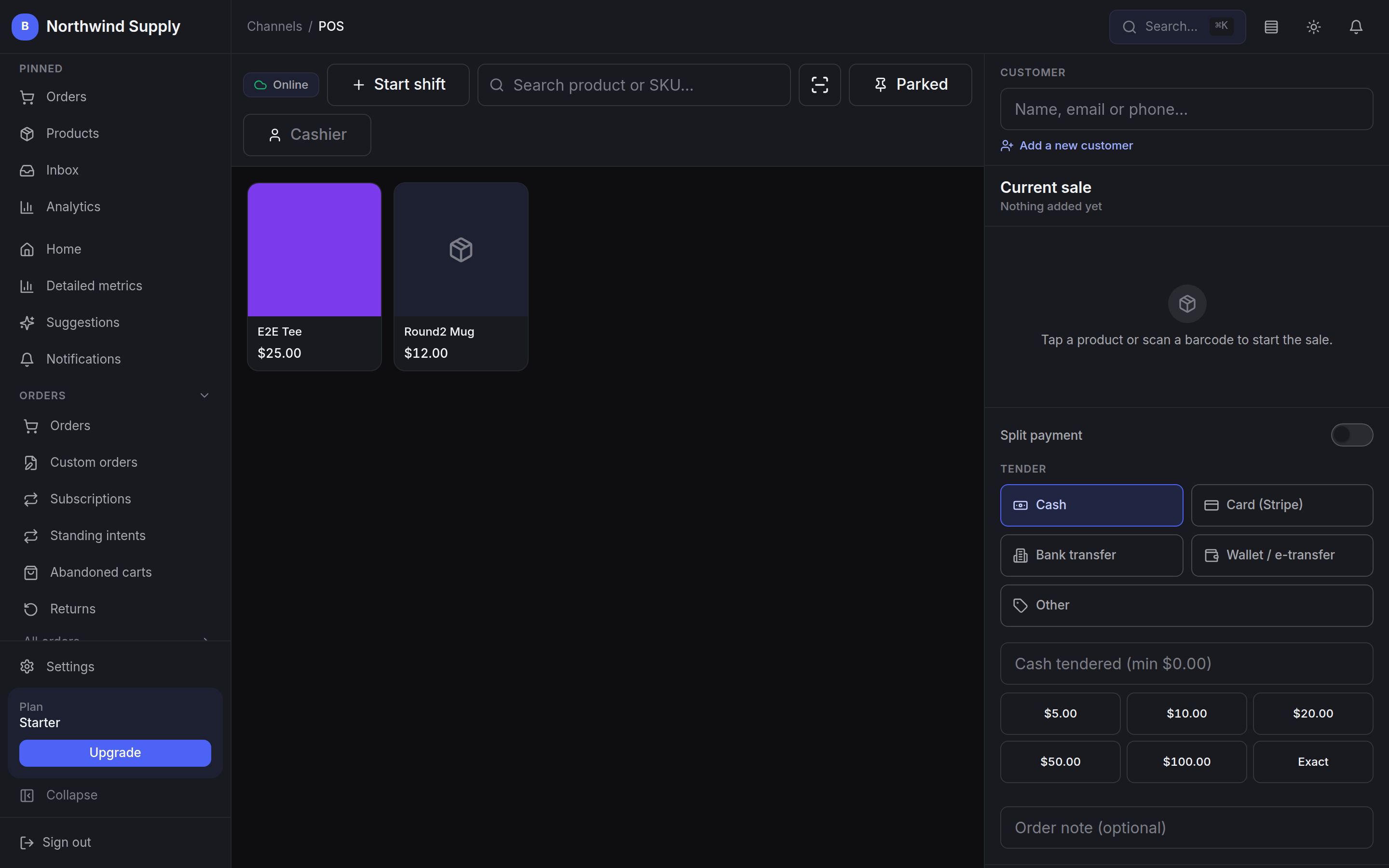
Point of sale with offline mode, split tender and staff PINs
On Shopify these register features sit on POS Pro, priced per location. Ours is on every plan, and a sale rung up with no signal is saved on the till and syncs once when the connection returns.
- BestWebby
- Built in
- Shopify
- Pro plan, per location
Shop floor and web selling from one stock ledger
Native on both. On BestWebby a register sale and a web sale move the same stock row, in the same transaction — there is no second counter to reconcile. Splitting that stock across several locations is included from the Growth plan up.
- BestWebby
- Built in
- Shopify
- Native too
Buy online, pick up in store
Native on both. BestWebby assigns the pickup to a location and re-attributes the stock when a staff member picks it.
- BestWebby
- Built in
- Shopify
- Native too
B2B accounts with price lists, credit limits and net terms
Scale plans and above
Shopify's B2B features belong to its highest tier.
- BestWebby
- Built in
- Shopify
- Top plan
Dropship and affiliate results under a search that comes up short
Growth plans and above
Ghost Search, with your own CJ Dropshipping, AliExpress or Amazon Associates account. Dropship items are bought through your normal checkout at your margin, and the supplier order is placed through your account after payment; Amazon items link out with your partner tag. BestWebby takes no fee on these sales.
- BestWebby
- Built in
- Shopify
- App required
Appointment booking with deposits and reminders
Growth plans and above
Services, staff hours and time off, and a booking page on your storefront that offers only free times. A deposit or the full price is taken through your own Stripe account with your store’s tax rules, and customers get reminders and a private link to cancel or move the booking within your policy.
- BestWebby
- Built in
- Shopify
- App required
Subscriptions and recurring orders
Growth plans and above
Shopify supplies subscriptions as an app you install rather than as part of the platform.
- BestWebby
- Built in
- Shopify
- Separate app
Run the operation
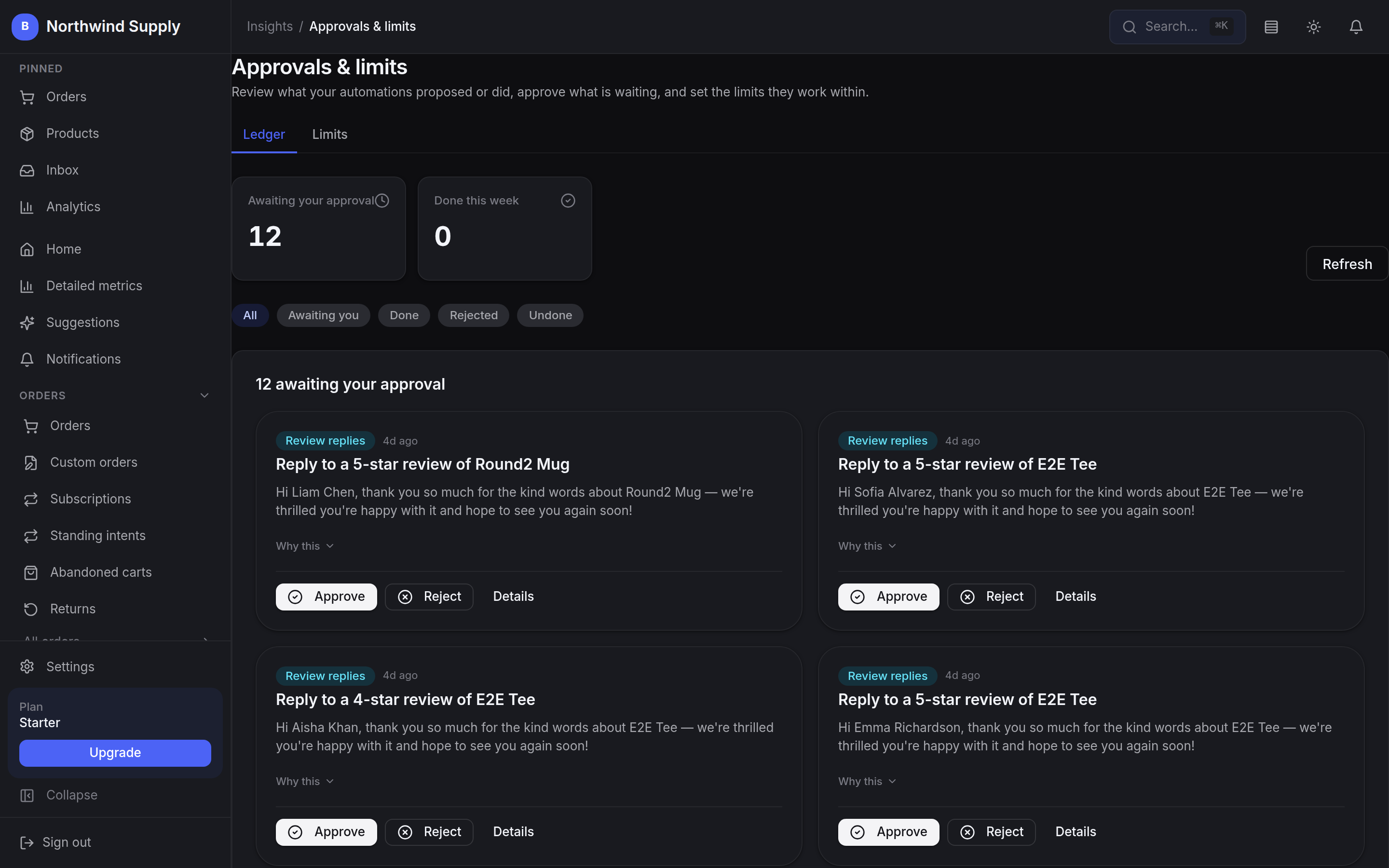
Proposals that wait in one queue for your approval
Every proposal shows what it would do and why, with Approve, Reject and an undo window, per-task limits you set, and a ledger of who decided what. The queue and its limits are on every plan; what fills it follows the capability — the markdown, stock and risk rows here.
- BestWebby
- Built in
- Shopify
- App required
Purchase orders and supplier management
Growth plans and above
- BestWebby
- Built in
- Shopify
- App required
Recalls that freeze the stock, trace the buyers and notify them
Scale plans and above
Name the affected SKUs and batch: BestWebby freezes them, builds a case per buyer from the orders that contain them, emails each one a private link, and records who acknowledged it.
- BestWebby
- Built in
- Shopify
- App required
Markdown scheduler with a price floor and an approval gate
Growth plans and above
- BestWebby
- Built in
- Shopify
- App required
Unified customer inbox with SLA timers and CSAT surveys
Growth plans and above
- BestWebby
- Built in
- Shopify
- Separate app
Risk signals on the order line, with a hold you approve
Growth plans and above
Both flag risky orders. On BestWebby the score sits on the order row and a proposed hold — reversible, and only ever a pause on fulfilment — waits in the approvals queue. Nothing is cancelled or refunded on your behalf.
- BestWebby
- Built in
- Shopify
- Native too
Own your setup
Mailbox on your own domain for store email
Shopify forwards mail at your domain; the mailbox itself comes from another provider. BestWebby provisions the mailbox and DKIM-signs what your store sends.
- BestWebby
- Built in
- Shopify
- Forwarding only
Custom domains with certificates issued and renewed for you
Native on both. BestWebby shows you the exact DNS records at every step, and nothing goes live until you've published them.
- BestWebby
- Built in
- Shopify
- Native too
API over your products, orders, customers and stock
Both have an API. Ours reads products, orders, customers and stock; creates, updates and archives products, adjusts stock, fulfils orders and manages webhook subscriptions — scoped keys, cursor pagination, signed webhooks for what changes. Customers and orders are not created through it. It is on every plan, with no app to publish first.
- BestWebby
- Built in
- Shopify
- Native too
Your catalogue, customers and orders leave with you
Both export. On BestWebby one action in Settings also writes every record the platform holds for your store to a single archive — not only the catalogue, the customers and the orders.
- BestWebby
- Built in
- Shopify
- Native too
| Capability | BestWebby | Shopify |
|---|---|---|
| Money | ||
| Added platform fee on sales through your own gatewayShopify's published rate for orders taken through a third-party gateway. It varies by plan and is waived on Shopify Payments. | 0% | Up to 2% |
| One subscription, with no per-register or per-location chargeShopify prices the register per location on top of the store plan. Opening a second till or a second location does not add a line to a BestWebby bill. | Built in | Per-location plan |
| You keep your own payment processorBoth support it. On BestWebby the charge is made on your own Stripe account, at whatever rate you negotiated, and we take no share of it. | Built in | Native too |
| Sell everywhere | ||
| Point of sale with offline mode, split tender and staff PINsOn Shopify these register features sit on POS Pro, priced per location. Ours is on every plan, and a sale rung up with no signal is saved on the till and syncs once when the connection returns. | Built in | Pro plan, per location |
| Shop floor and web selling from one stock ledgerNative on both. On BestWebby a register sale and a web sale move the same stock row, in the same transaction — there is no second counter to reconcile. Splitting that stock across several locations is included from the Growth plan up. | Built in | Native too |
| Buy online, pick up in storeNative on both. BestWebby assigns the pickup to a location and re-attributes the stock when a staff member picks it. | Built in | Native too |
| B2B accounts with price lists, credit limits and net termsScale plans and aboveShopify's B2B features belong to its highest tier. | Built in | Top plan |
| Dropship and affiliate results under a search that comes up shortGrowth plans and aboveGhost Search, with your own CJ Dropshipping, AliExpress or Amazon Associates account. Dropship items are bought through your normal checkout at your margin, and the supplier order is placed through your account after payment; Amazon items link out with your partner tag. BestWebby takes no fee on these sales. | Built in | App required |
| Appointment booking with deposits and remindersGrowth plans and aboveServices, staff hours and time off, and a booking page on your storefront that offers only free times. A deposit or the full price is taken through your own Stripe account with your store’s tax rules, and customers get reminders and a private link to cancel or move the booking within your policy. | Built in | App required |
| Subscriptions and recurring ordersGrowth plans and aboveShopify supplies subscriptions as an app you install rather than as part of the platform. | Built in | Separate app |
| Run the operation | ||
| Proposals that wait in one queue for your approvalEvery proposal shows what it would do and why, with Approve, Reject and an undo window, per-task limits you set, and a ledger of who decided what. The queue and its limits are on every plan; what fills it follows the capability — the markdown, stock and risk rows here. | Built in | App required |
| Purchase orders and supplier managementGrowth plans and above | Built in | App required |
| Recalls that freeze the stock, trace the buyers and notify themScale plans and aboveName the affected SKUs and batch: BestWebby freezes them, builds a case per buyer from the orders that contain them, emails each one a private link, and records who acknowledged it. | Built in | App required |
| Markdown scheduler with a price floor and an approval gateGrowth plans and above | Built in | App required |
| Unified customer inbox with SLA timers and CSAT surveysGrowth plans and above | Built in | Separate app |
| Risk signals on the order line, with a hold you approveGrowth plans and aboveBoth flag risky orders. On BestWebby the score sits on the order row and a proposed hold — reversible, and only ever a pause on fulfilment — waits in the approvals queue. Nothing is cancelled or refunded on your behalf. | Built in | Native too |
| Own your setup | ||
| Mailbox on your own domain for store emailShopify forwards mail at your domain; the mailbox itself comes from another provider. BestWebby provisions the mailbox and DKIM-signs what your store sends. | Built in | Forwarding only |
| Custom domains with certificates issued and renewed for youNative on both. BestWebby shows you the exact DNS records at every step, and nothing goes live until you've published them. | Built in | Native too |
| API over your products, orders, customers and stockBoth have an API. Ours reads products, orders, customers and stock; creates, updates and archives products, adjusts stock, fulfils orders and manages webhook subscriptions — scoped keys, cursor pagination, signed webhooks for what changes. Customers and orders are not created through it. It is on every plan, with no app to publish first. | Built in | Native too |
| Your catalogue, customers and orders leave with youBoth export. On BestWebby one action in Settings also writes every record the platform holds for your store to a single archive — not only the catalogue, the customers and the orders. | Built in | Native too |
- Part of the platform — nothing to buy or install
- Native on Shopify as well
- Growth · ScaleThe plan a capability is included from, where that is above the first one
The Shopify column describes Shopify's published plans and app store. “App required” means the capability comes from an app rather than from the platform itself; it is not a statement about what any app costs. Where our column names a plan, that is the plan the capability is included from — it still arrives as part of the platform, with nothing extra to install or keep updated.
In the product
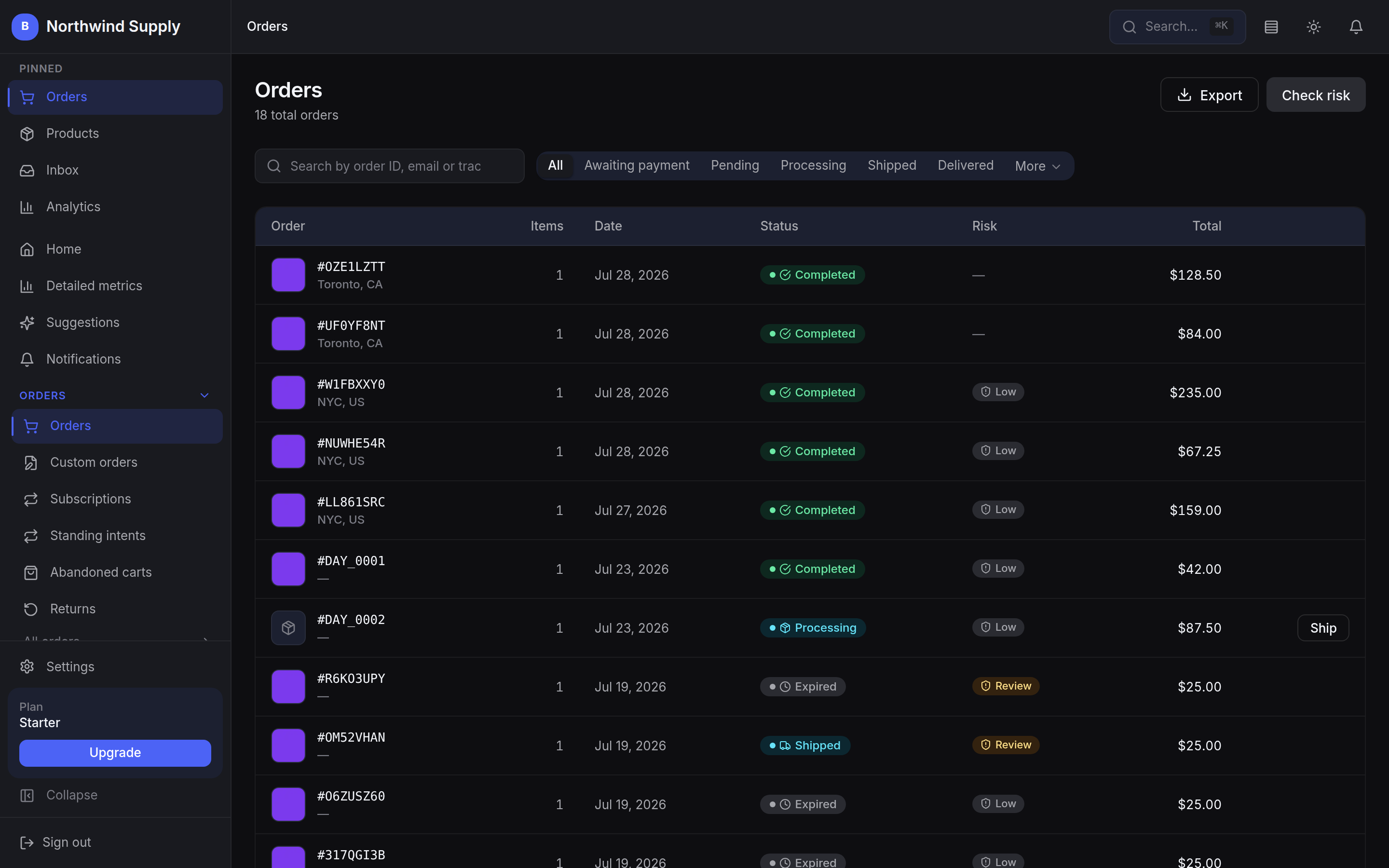
One order list, wherever the sale came from.
Storefront, register and connected channels write to the same orders table, with fulfilment status and a risk rating on every line. There is no app to install to see them together, and no second system to reconcile at the end of the day.
In the product
Nothing moves until you say so.
The queue behind the approval rows above. Every proposal your automations make lands here with what it would do and why, and it waits: approve it, reject it, or open the detail. The second tab is where you set how far each task may go on its own.
The math
A single-location shop doing $10,000 a month
Figures use Shopify's published Basic plan billed monthly, its stated fee for orders taken through a third-party gateway on $10,000 of sales, and POS Pro at one location. Anything you install sits on top of that. Ours is the Starter plan — one storefront with the register included and unlimited products — plus tax; no setup fee, no transaction fee, nothing left out of this number. Your own numbers will differ by plan, region and country — but the shape does not: our price does not move when your sales do, and the register is not a line of its own however many tills you open.
Monthly cost lines
IllustrativePlatform subscription
- BestWebby
- $15
- Shopify
- $39
Added fee on your own gateway
- BestWebby
- $0
- Shopify
- $200
Register at one location
- BestWebby
- Included
- Shopify
- $89
Estimated monthly total
- BestWebby
- $15
- Shopify
- $328
Card processing is billed by your own processor at your own rate. We do not mark it up and we do not add a platform fee on top of it.
Moving from Shopify?
Export your catalogue to CSV and import it — each product arrives with its options, variants and images, columns auto-detected, everything created as a draft so you review before publishing. Build the storefront and run a test purchase through it before you touch DNS: your Shopify store keeps selling right up to the moment you point the domain across.